Tuesday, 4 March 2014

The Garden of Kent - Birds and Bees

One of the enjoyable aspects of our stay in Kent is looking out of the window at the bird feeders and seeing the variety of birds.
 
As well as the more usual robins, wren, blackbirds and thrush, we have watched birds very close up, just outside the windows.
Here are some of them (photos taken from the web!)
 
 Chaffinch


        Great tit                                                                       Blue tit
 
                                          
        Long-tailed tit                                                             Collared dove 
 
                           
        House sparrow                                                        Hedge sparrow or dunnock?       
 
       
   Green woodpecker - feeds like a thrush         Greater spotted woodpecker - loves peanuts
 

There are also 5 hives in the orchard - kept by a local beekeeper.
One of my jobs is to check they haven't been dislodged by the storms and the anti-woodpecker netting is intact (apparently, the local woodpeckers have a taste for honey?!)


Bees buzzing out - on a sunny day in Jan
 
Mr. Beekeeper 
 
Beekeeper Apprentice
 
The netting and bricks need taking off, to get the roof off!
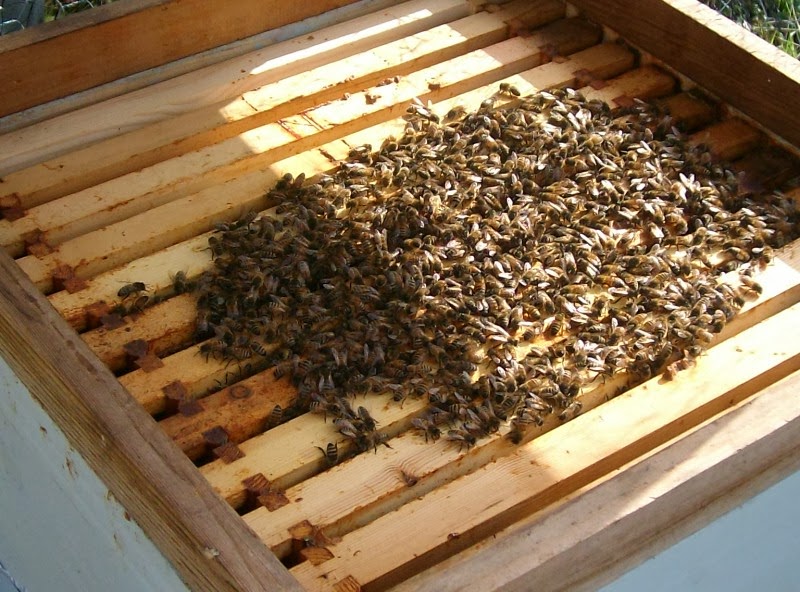
 
A good quantity of bees that have been feeding on the sugar supplement (removed)
 
 
This is a pollen fondant supplement to go with the sugar one, that was put back
 
Job done until early April, when the hive is opened up for inspection of the queen and it is warmer for the bees!


Tuesday, 25 February 2014

Bluebell Steam Railway – East Sussex February 2014

Whilst we are down in Kent, we wanted to go to the Bluebell Railway.
I had been there just the once before, many years ago.

As it was Half-term we had the pleasure of our Granddaughter with us.
What a wet day! Fortunately, the comfort of a warm, steam heated compartment did the job!

Restored to 1920's, the Southern Region Horsted Keynes Station
 
The first loco of the two train timetable: U Class 2-6-0, Maunsell 1931 Southern Region loco

There are only 4 left in preservation now out of the 50 built. They were able to operate over most of the Southern Railway network, gaining the nickname “U -boats” after the submarine warfare of the First World War as they could go anywhere. With a British Railway power classification of 4P3F, they continued to operate with BR until 1966.

  T
The Fireman gets up onto the coal
 
A view from the cab
 
Coming north into Horsted Keynes Station – see link
 
Note the signal gantry gives the Platform Number
 
Permanent Way work

It belted with rain for the run north with the U Class easily dealing with a gradient of 1 in 55 at it's steepest. We went through the new cutting at Imberhorne on the newish route to East Grinstead. It was interesting to see the depth of rubbish tip that had to be cut away.
 

A view of the 'rubbish tip' cutting – see clip of 1638 through the cutting
 
 
Arriving at East Grinstead
 
Signalling with white 'backplate'
 
Our second loco was No. 263, the South East and Chatham Railway's 1905 H Class.
We travelled in a 4 – coach train, again in the rain though the steam heating kept us warm.
No.263 at Sheffield Park Station
 

Grandma and Granddaughter enjoying the delights of steam travel
 
Father and Son 
 

Steam train enthusiasts! Last passengers!


Friday, 21 February 2014

Snowdrops Supreme!

Last Sunday was rather chilly though dry, with weak winter sunshine to show off the snowdrops! We visited a local (to our stay in Kent) garden, open as part of the National Garden Scheme.

Mere House was built in 1780 as the rectory of Mereworth Parish by the patron, 21st Lord Le Despencer, who was also Chancellor of the Exchequer and Postmaster General.

The house had been extended in the early 19th century and altered in 1876 to include the front porch – the architect's Assistant at the time was the celebrated novelist, Thomas Hardy.

Front entrance to Mere House, note the offset front with the north extension

The garden is some 6 acres, with ornamental trees, lake, woods and lawns. The openess of the garden has resulted in storm damage to trees and the kitchen glasshouses in the great storm of 1987 and in 1990. At this time of year, there were banks of snowdrops shining in the low afternoon sun.


We sat out for tea and cake – enjoying the fresh air!


Sunday, 9 February 2014

Thomas aka Jessie – a Hunslet 0-6-0 1937 Loco

Last weekend, I was back up in Staffs to watch the rugby with my brother.
After the last minute disappointment of England being overhauled, we took off to North Wales on the Sunday. To the Llangollen Heritage Railway.

Purchasing a day rover gave us three full return journeys behind the day's loco.

Three coaches were comfortably headed up the initial 1 in 80 to Berwyn Station by the industrial Hunslet 0-6-0 Saddletank No.1837.
This 1937 loco worked at Eastmoors Steel Works, Cardiff before being withdrawn in 1965, into preservation. Eventually ending at Llangollen Railway and restored to working order in 2003.


No.1837 named 'Jessie' at Crewe Works Centre in 2005

Llangollen Ralway have 'modified' the Hunslet into the ever-popular Thomas the Tank Engine. We were told that 'Thomas' days are still a major fundraiser for the heritage railway even though 28% of takings are levied by the Thomas Franchise.

'Thomas' – minus saddle watertank, face and number – takes on water
 
The boiler back plate – there was a sticky left injector!
 
Heading west up the Berwyn Incline
 
A view down to the River Dee and the Chain Bridge Hotel
 
The picturesque Berwyn Station – see this link for Jessie pulling away up the 1 in 80
 
Entering the Berwyn Tunnel
We had the enjoyable experience of travelling in the guards coach and talking with the Guard – an ex BR Shrewsbury Freight Yard. The guard showed enthusiasm for his job!

Guard gives the green flag right of way! See this link for the real thing!

Homeward bound from Stafford Station - Siemens EMU

Thursday, 30 January 2014

Test of navigation – failed!

Southern Orienteering Champs – January 2014

Readers of the blog will have seen posts about my orienteering comeback since my retirement some 2 years ago. Most of this has been on the fells with large scale 1:40 000 maps. I have also some entered local orienteering events, mainly being last or last but one!

So, with anticipation and apprehension, I entered my biggest O-challenge yet, the Southern Championships, held on 26/01/14 in Bracknell Forest, about an hour drive from where we are currently staying in Kent.

The following photos are gratefully taken from David Jukes Flicker page. See here
None of them feature myself - they are for interest though.
Long drive into the forest
 
 
Heading to park - in the rain!
Walking to register

Inside the Registration tent -see the electronic recording gear
 
Waiting at the south start - count down in minutes
 
Crossing the start line to get the map and list of controls to find - this is the first time that they are seen
 
 
Finding a control - hidden behind a large bush 
 
 
Out in the forest
 
This control is partially hidden in a ditch
 
Almost back at the finish!


Relieved to be back!


 The wet drive back out of the forest!
 
The event is at national level – a real test of navigation!

To be honest, I really struggled with some of the technical aspects of the navigation, losing considerable time in the process.

When my route finding went well, my running ability and fitness placed me in the lower half of the pack of orienteers. When I got lost – well, I lost loads of time.
The map scale was at 1:10 000 and I still tend to over-run at this scale.

Eventually time overtook me and I ran out of time to get all the controls and so finish the course! Technically therefore, this resulted in a disqualification!       

Failed in my test of navigation!
Results:
Southern Champs M60 Long course – 8.5km with 220m of climb. 16 controls in 2hr39mins

Until the next time then!